Journey
from
the
very
haunted
sidewalks
of Bourbon
Street
in the
old
French
Quarter,
to the
serene
cool
waters
of the
heart
of Bayou
of St.
John;
or,
just
take
a leisurely
streetcar
ride
along
the
newly-reopened
Canal
Street
line
and
pay
a visit
to one
of New
Orleans’Historic
Cemeteries.
In Haunted
New
Orleans,
"The
Fabled
Cities
Of The
Dead"
await
you...
Tales
of the
Yellow
Plague,
heroes
from
the
War
of 1812
and
the
Civil
War,
of a
pirate’s
lost
soul
and
magic
marks
on Madame
Marie
Laveau’s
aging
tomb
- all
can
be found
among
the
restful
dead
of haunted
New
Orleans’
vast
historic
old
cemeteries.
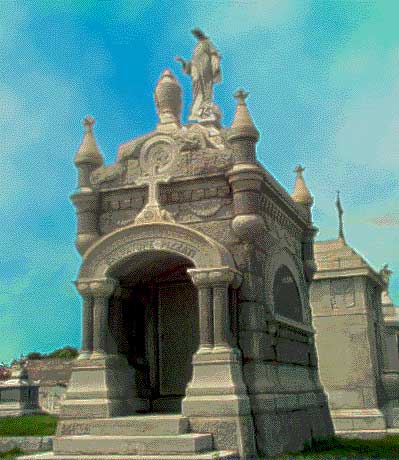
Adorned
in marble,
lined
with
red
bricks
and
aging
roses
of rusted
wrought
iron
the
tombs
of New
Orleans’
Cities
of the
Dead
are
magnificent
examples
of architectural
masterpieces
designed
to commemorate
the
sleeping
dead
in their
eternal
rest.
A vast
city
of generations
wrapped
in sleep,
their
monuments
reach
to the
blue
heavens
in all
their
splendid
grandeur
and
decay.
View
the
exquisite
artisanship
and
humble
memorials,
blessed,
and
mourned
everlasting.
New
Orleans’
cemeteries
are
truly
jewels
of history
and
memory
in the
heart
of the
great
Crescent
City.
by
A. Pustanio
photos by
Jules Richard
artwork
by Ricardo
Pustanio
One
should never
leave Haunted
New Orleans
without
visiting
at least
one of the
40 famous
aboveground
cemeteries.
You will
not be disappointed,
no matter
how many
times you
visit. But
if you’re
looking
for more
than amazing
monuments,
you might
just have
found the
place.
METARIE
CEMETERY
The history
behind
the vast
"Cities
Of The
Dead"
is very
fascinating.
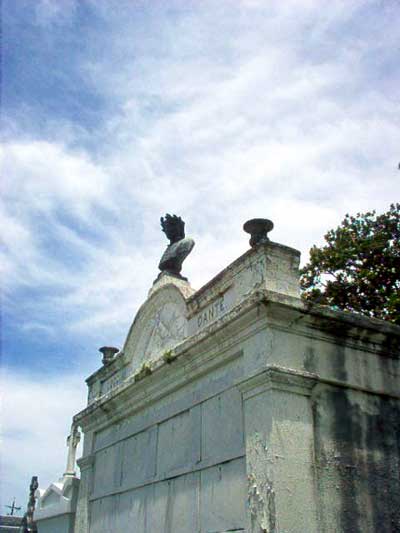
The tombs
were first
built
aboveground
because
the City
lies more
than nine
feet below
sea level
and thus
the high
water
table
would
often
push coffins
and their
contents
back out
of more
traditional
grave
sites.
The oldest
tombs
are either
free-standing
one or
two level
structures
or the
“brick
oven”
type that
were the
forerunners
of the
modern
mausoleums.
Ingenuity
met necessity
and soon
cemeteries
were beginning
to be
the site
of major
architectural
memorials
of finest
granite
and marble,
some adorned
with bronze
urns or
great
statues
or with
handcrafted
wrought
iron fences
that rivaled
the intricate
work that
adorns
the haunted
balconies
of New
Orleans.
Another
aspect of
these great
monoliths
is that
they were
constructed
to receive
multiple
burials
from any
one family.
By using
the built-in
receiving
vault in
the back
for the
removal
of excess
remains,
many generations
of the famous
and anonymous
New Orleans
families
might find
their eternal
rest all
together
to make
room for
other family
members
literally
dying to
get in .
. . Many
consider
the thought
comforting,
that you
know you
will never
be buried
alone in
one of New
Orleans’
great old
tombs.
Many that
visit the
tombs realize
that there
is much
more to
these cemeteries
than interesting
statues.
Or famous
historical
figures
laid in
tombs that
make up
the very
walls. The
mystery
and even
haunted
highlights
of famous
resting
residents
such as
Marie Laveau
and Homer
Plessy (of
the famed
Plessy vs.
Ferguson
case), Louis
Prima, And
a host of
other well
known notables.
The first
known cemetery
in New Orleans
was once
located
at the corner
of St. Peter
and Burgundy
Streets
in the French
Quarter.
Called “St.
Peter’s
Cemetary”
burials
in this
location
(primarily
below ground)
began as
early as
1721 and
continued
until 1800.
What is
left of
St. Peter’s
is now concealed
under the
properties
there. Hauntings
and sightings
at this
location
have been
reported
since its
rediscovery
in the 1970’s
- 80’s
when teams
from Tulane
University
conducted
an archeological
dig at the
location
of the former
cemetery.
Disgruntled
spirits
perhaps?
There are
three cemeteries
dedicated
to St. Louis
in the Crescent
City, but
St. Louis
No.1 is
by far the
oldest and
most well
known of
the three.
St. Louis
No. 1 is
the “Hollywood”
of New Orleans
cemeteries
and has
its own
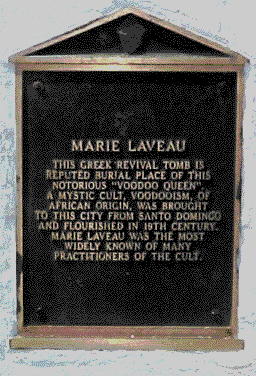
star, Madame
Marie Laveau,
the famous
Voodoo Queen
of New Orleans.
Or, depending
on who you
talk to,
it has a
tomb that
many people
believe
contains
her remains.
Records
are sketchy
and no one
is quite
sure. But
if the dedication
of legions
of her faithful
admirers
is any indication,
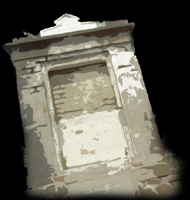
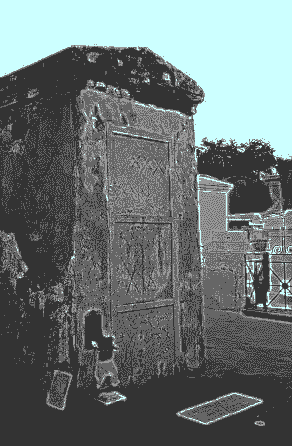
the white
washed tomb
in St. Louis
No. 1 probably
is the final
resting
place of
the Witch
Queen’s
earthly
remains.
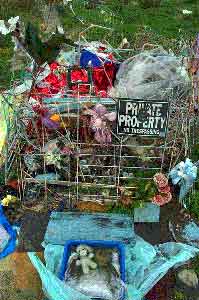
Devoted
followers
and tourists
alike leave
mementos
and offerings
in front
of the crumbling
marble face
plates of
the tomb,
now scored
entirely
with the
crude X’s
that mark
the wishes
asked for
from this
famous Lady.
Practitioners
and
followers
of
Marie
Laveau
make
pilgrimages
to
her
famous
white
washed
tomb
in
hopes
of
capturing
her
favor
and
perhaps
some
of
her
lingering
magic
powers.
Old
legends
suggest
that
the
faithful
are
told
to
mark
three
red
X’s
on
her
tomb
(it’s
getting
hard
to
find
a
free
spot
these
days),
make
a
special
wish,
and
to
knock
loudly
three
times
to
awaken
the
spirit
of
the
great
maMbo.
XXX
The
petitioner
must
then
turn
round
clockwise
three
times
in
front
of
the
tomb
and
bow
before
turning
away.
Still
others
go
to
the
tomb
of
Marie
Laveau
to
ask
her
help
in
removing
jinxes
and
hexes
they
feel
have
been
cursing
them.
It
is
said
that
modern
members
of
the
secret
society
founded
by
Marie
Laveau
in
her
lifetime
come
to
the
cemetery
for
night
time
rituals
designed
to
commemorate
her
life
and
to
ask
her
intercession
and
aid
in
their
petitions.
Evidence
of
these
clandestine
rituals
is
found
in
the
many
floral
tributes
and
offerings
that
accumulate
daily
at
the
grave
site.
Zombi
Brand
Candles
and
good
luck
Monkey
and
Cock
statues
are
said
to
be
a
good
indication
that
members
of
Laveau’s
original
society
have
paid
a
visit
to
their
manbo.
Others
leave
Mardi
Gras
beads,
cigars,
Florida
Water
cologne,
food,
and
hairdressing
tools
or
accents
(in
her
lifetime,
Laveau
was
a
practicing
hairdresser
serving
an
elite
clientele).
Followers
and dabblers
alike
have attested
that the
great
Marie
Laveau
does not
ignore
any request
and many
claim
that she
is responsible
for “miracles”
in their
lives.
Like
the ruins
of any
great
city of
the past,
time is
it's destroyer,
decaying
ruins
of each
memory
that stands
against
time.
A Local
New Orleans
group
"Save
Our Cemeteries"
has taken
up the
wonderful
restoration
cause,
and one
by one
is restoring
lost tombs,
wall vaults
and forgotten
family
tombs
(the old
“ovens”)
with no
apparent
heirs
left to
care for
them,
left in
almost
total
disrepair
next to
the marbled
fresh
facades
of others.
One
warning
though:.
Many tourist
who visit
Haunted
New Orleans
Cemeteries
can assure
you, unless
you are
careful,
you might
not come
out alive.
A well placed
plaque from
the Archdiocese
of New Orleans
explaining
the lack
of security
in inner
city St.
Louis Nos.
1 and 2.
The plaque
warns against
the dangers
of touring
these two
cemeteries
alone. The
very best
and most
informative
way to visit
the famous
urban cemeteries
is to take
one of the
many guided
cemetery
tours.
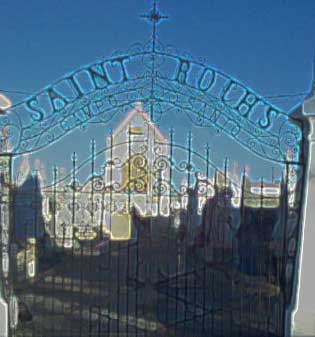
St.
Roch
#1
(established
1872)
1725
St.
Roch
Ave.
Owned
by
New
Orleans
Archdiocesan
Cemeteries
St.
Roch
most
believe
that
he
was
born
in
Montpellier,
France,
around
1295.
His
father
was
governor
of
the
town.
It
is
said
that
St.
Roch
was
marked
at
birth
with
a
red
cross
on
his
chest.
As
the
story
goes,
he
was
orphaned
at
age
20,
gave
all
his
fortune
to
the
poor,
gave
the
governorship
to
his
uncle,
and
went
on
a
pilgrimage
to
Rome.
On
the
way,
he
stopped
at
a
town
stricken
by
the
plague.
The
young
man
healed
the
people
and
moved
on.
Everywhere
he
visited
in
Italy,
he
cured
all
those
he
touched.
Then
he
was
himself
stricken
at
Piacenza.
Rather
than be
a burden,
he hid himself
in a hut
in a forest.
And here
comes the
best part.
A dog found
him, licked
his wounds,
and brought
him a small
loaf of
bread each
day until
he recovered.
Eventually,
he made
his way
home to
France,
but his
relatives
did not
recognize
him, and
he refused
to reveal
his identity.
In his
disguise
as a pilgrim,
he was
taken
for a
spy and
thrown
into prison
by order
of the
governor.
There
he died
five years
later
in 1327.
The
red cross
on his
breast
and documents
in his
possession
proved
his identity,
and 100
years
after
his death
he was
canonized.
Our
own St.
Roch Cemetery
on St. Roch
and Derbigny
streets
was created
to honor
this saint.
In 1868,
New Orleans
was afflicted
by a yellow
fever epidemic,
one of many
scourges
that plagued
the city.
Father Peter
Leonard
Thevis was
a priest
from Germany
and pastor
of the Holy
Trinity
Catholic
Church.
He remembered
that people
were helped
by St. Roch
during times
of pestilence,
so he and
his congregation
prayed to
St. Roch
to help
them during
this crisis.
The priest
promised
that he
would build
with his
own hands
a chapel
to the saint.
Of course,
legend has
it that
not a single
parishioner
died, and
Father Thevis
kept his
promise.
He
also planned
a cemetery,
begun in
1874, along
with the
shrine,
and it was
modeled
after the
famous Campo
Santo dei
Tedesci
(Holy Field
of the Germans)
near St.
Peter's
in Rome.
The cemetery
was like
the older
ones in
New Orleans,
surrounded
with wall
vaults.
Another
section
of the cemetery
was added
in 1895.
The
chapel
resembles
a small
chancel
of a Gothic
church
and was
completed
in 1876.
Made of
carved
and painted
wood,
the altar
has a
small
statue
of St.
Roch and
his faithful
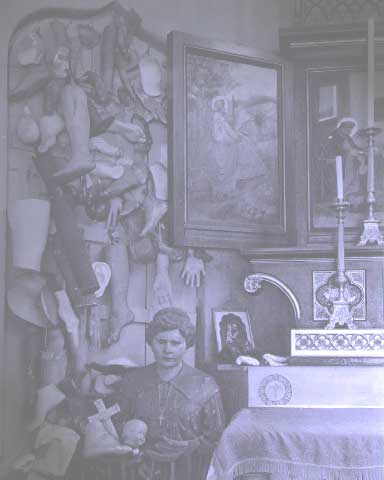
dog. For
years,
the shrine
has been
popular
with the
faithful,
and many
have left
behind
artificial
limbs
and crutches
that testify
to the
miraculous
cures
worked
through
the intercession
of the
saint.
SAINT
ROCH CEMETERY
CHAPEL
Under
the floor
in front
of the
altar
lie the
remains
of Father
Thevis.
For many
years
on Good
Friday,
young
girls
would
make a
pilgrimage
to St.
Roch's
Chapel.
They believed
the local
legend
that maidens
who visited,
prayed
and left
a donation
in nine
churches
on that
day would
be promised
a husband
before
the end
of the
year.
It was
especially
lucky
to end
the pilgrimage
at St.
Roch's.
The young
ladies
would
pick a
four-leaf
clover
from the
cemetery.
These
clovers
were different
because
they had
red spots
on them
which,
according
to legend,
resulted
when a
bride-to-be
committed
suicide
on the
grave
of her
intended
and spattered
blood
everywhere.
St.
Roch and
his cemetery
have been
recognized
by many
others.
The Louisiana
State Museum
has a wonderful
painting
of the St.
Roch Cemetery
and Shrine
created
by Louisiana
artist John
McCrady
in 1950-52.
And
Claremont,
Calif. is
home of
the St.
Roch Dog
Rescue,
an organization
dedicated
to saving
abandoned
and homeless
dogs that
has as its
motto, "Serving
people and
dogs of
all faiths
and no faith
at all."
As
you might
imagine,
St. Roch,
whose
feast
day is
Aug. 16,
is the
patron
saint
of dogs
and dog
lovers.